Implementation of EU Directive on cross-border conversions, mergers and divisions

Directive (EU) 2019/2121), known as the Mobility Directive, aims to eliminate unjustified barriers to the freedom of establishment of EU companies in the single market.

To achieve this aim, the Mobility Directive amends some of the existing rules on cross-border mergers in the EU and, for the first time, introduces rules on cross-border conversions and divisions for all Member States.

More

Extensive changes to the “Nachweisgesetz” require adaptation of German employment contracts

Coming soon to Germany: Implementation of the European Directive on Transparent and Predictable Working Conditions (EU) 2019/1152 (“Working Conditions Directive”).

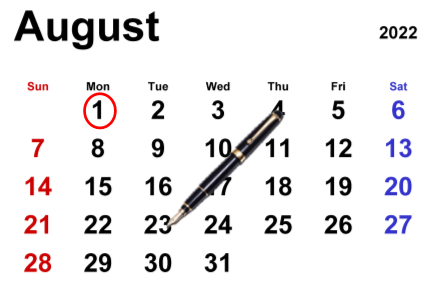
On 23 June 2022, the Bundestag decided to transpose the directive into national law. As of 01 August 2022, the changes will apply to all newly concluded employment contracts.

Are you ready for the coming changes?

Beck Rechtsanwälte‘s specialist Labour lawyers have been dealing intensively with the matter for months. Many of the new requirements are typically included in German employment contracts. An adaptation of such employment contracts is therefore manageable. Nevertheless, adjustment is necessary, as failure to provide verification information will be punishable by a fine.

The most important changes are:

  • The duration of the probationary period must be stated.
  • Information on a freely selectable place of work must be provided.
  • The actual working time and agreed rest breaks and times must be included. If shift work has been agreed, the shift system, the rhythm and conditions for shift changes must be stated.
  • The information required to give for on-call work is considerably more extensive.
  • The possibility of ordering overtime and its preconditions, as well as the concrete remuneration for it, must also be indicated.
  • The wage components (allowances, supplements, bonuses, special payments) must be broken down individually.
  • Information must be given on training offered by the employer.
  • Now also applies to temporary workers.

The probationary period of fixed-term employees must be adapted to the duration of the fixed term. If the probationary period is too long, it will be invalid.

Probably the most significant change concerns the information in connection with the procedure in the event of a termination. In this respect, please note.

  • requirement of written form
  • deadlines for termination of the employment relationship
  • time limit for bringing an action for unfair dismissal.

The amendments only directly affect employment contracts that will be concluded from 01 August 2022. However, since the deadlines for providing this verification information have been reduced and verification information must partly be available on the first day of the employment relationship, you must act now.

Please also note that old contracts dating from before 01 August 2022 are indirectly affected. According to the current draft of the law, employees with old contracts must be provided with the verification information upon their request within one month, in some cases even on the seventh day after their request.

Please feel free to contact us and our specialist Employment lawyers will be happy to assist you.


Azevedo Sette Advogados is recognized in Private Wealth Law by the Chambers HNW 2022 guide

Azevedo Sette Advogados  were recognized by Chambers High Net Worth 2022, the Chambers and Partners’ guide that ranks the leading lawyers and law firms for international private wealth.

With only 19 law firms recognized by the guide in Brazil, Azevedo Sette, with our Wealth Planning Partner and Italian Desk lead, Rafael Bassoli highlighted, received praise for excellence in the areas of investments, management and succession, patrimonial and tax planning, in national and cross-border cases.

The presence of our practitioners in guides such as Chambers HNW is a reflection of their dedication, commitment and consistently excellent work. Congratulations to all on this latest achievement!

Feedback

The award states that Azevedo Sette Advogados are “very articulate, especially the partners who have relevant expertise in tax matters,” and that it has “specialists in virtually every interrelated area of law providing a holistic legal solution for Brazilian cross-border legal work.”

Notable practitioners

Rafael Bassoli received special mention: “very talented and knowledgeable on tax matters and cross-border matters” and is “very client-centric and has a practical, solution-oriented approach to legal services. Whereas some attorneys are master issue spotters, he is solutions-focused.”

The senior partner Fernando Azevedo Sette is the lead of the HNW practice at the Azevedo Sette Advogados.

For more on the rankings as well as how firms are ranked, go to https://lnkd.in/eAnWkzir.

Foreign tax credit under American new legislation and Brazil’s convergence towards OECD guidelines

On December 28, 2021, the American Treasury Department released final regulations (TD 9959, Final Regulations) regarding foreign tax credit (FTC) to be offset in the USA. In a nutshell, according to the referred legislation, in order to be offset, the tax paid abroad must be reasonably similar to US tax rules.

Brazilian tax legislation does not hold the principles that would allow Brazilian FTC in the US under TD 9959. Brazil levies withholding taxes (WHT) at the payment source, unlike the production source required by the new US legislation. Additionally, Brazilian transfer pricing (TP) rules are not currently under Organisation for Economic Co-operation and Development (OECD) guidelines, i.e., the arm’s length principle (ALP) is not strictly observed.

In this sense, if there is a WHT burden on a remittance from Brazil to the US, the WHT offset would not be allowed for the American taxpayer. Also, considering the scenario of a Brazilian company as a subsidiary of an American entity, there would be no FTC regarding Global Intangible Low-Taxed Income (GILTI) legislation – American Controlled Foreign Companies (CFC) rules.

Nevertheless, Brazil has initiated its accession process for OECD membership. A Roadmap was published by the Organization on June 10, 2022, which says that OECD Committees will evaluate Brazilian legislation and propose alterations to enable Brazil’s accession. The Federal Decree #11.105 was published in Brazil on June 27, 2022, determining the domestic groups that will develop the analysis along with OECD Committees.

Brazilian Federal Revenue (RFB) already initiated the studies about the legislative changes that are needed regarding TP: a new approach under OECD guidelines was presented by the RFB, which affirmed that the respective bill will be available soon in order to start the legislative process. A seminar hosted by RFB and IDB (Inter-American Development Bank) occurred on June 29, 2022, demonstrating the updates on the convergence towards OECD standards. The private sector was invited to present its inputs and multiple countries’ representatives shared their experience with OECD guidelines so that Brazilian tax authorities could be prepared regarding its system.

In addition, international commerce organizations have been discussing the TD 9959 with the Brazilian Economy Ministry, pointing out that there will be a double taxation between Brazil and the US. At a recent meeting, it was proposed that Brazil should request US Treasury an extension of two (2) years for starting the application of the new rules, so that Brazil would have time to accommodate US requirements on its legislation. The new approach for TP and the negotiation of a Double Tax Treaty (DTT) were also discussed, focusing on having the TP bill as soon as possible and then initiating the DTT discussions.

At the seminar which took place on June 29, however, the USA representative said that the Final Regulations will need to be applied by the end of 2022 and that the observance of the ALP in Brazil is a condition to start the discussions for the DTT.

We emphasize, though, that there is no need to have a DTT in order to have FTC in the USA: if the TD 9959 requirements are met, the credit is allowed. Additionally, before the Final Regulations, it was possible to offset Brazilian FTC in the US.

Taxpayers should, therefore,  observe the next steps in Brazil’s convergence towards OECD guidelines, especially regarding the possibility of American entities offsetting Brazilian FTC.

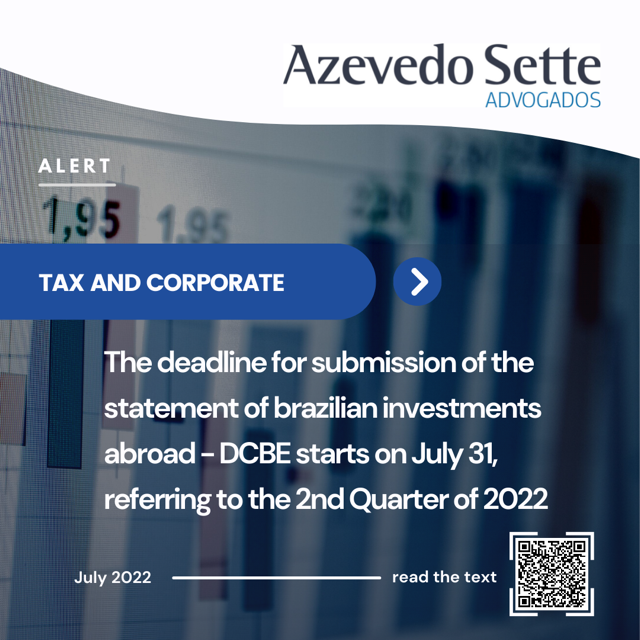
The deadline for submission of the statement of Brazilian investments abroad starts on July 31, referring to the 2nd Quarter of 2022

Investments made outside of Brazil must be declared by individuals or legal entities resident or headquartered in Brazil, annually or quarterly, according to the value of their assets and rights abroad.

Who is required to submit?

The Statement of Brazilian Investments Abroad (DCBE), referring to the 2nd Quarter of 2022, is mandatory for individuals or legal entities resident, domiciled or headquartered in Brazil, including foreign citizens residents in Brazil, who hold assets and rights outside Brazil totalling:

  • an amount that is equal to or greater than USD 100,000,000.00, or equivalent in other currencies, on June 30, 2022 – Quarterly CBE (2nd Quarter 2022).

What is the deadline? 

  • 18h00 on September 5, 2022, for a quarterly statement referring to the base date of June 30, 2022;

Is there a fine? 

Non-compliance or inadequate compliance with the obligation subjects the violator to the application of a fine by the Central Bank of Brazil, increasingly active in this area, as follows:

  • Making a registration or submitting a statement in disagreement with the deadlines provided for in the respective rules: 1% of the amount subject to registration or statement, limited to BRL 25,000.00;
  • Providing incorrect or incomplete information: 2% of the amount subject to registration or statement, limited to BRL 50,000.00;
  • Failure to register, failure to submit the statement, or failure to present documentation supporting the information provided to the Central Bank of Brazil:

5% of the amount subject to registration or statement, limited to BRL 125,000.00, or

  • Providing false information in a registration or statement: 10% of the amount subject to registration or statement, limited to BRL 250,000.00.

The Tax and Corporate teams of Azevedo Sette Advogados are at your disposal for guidance and clarification of doubts on the subject matter, as well as for assistance with the submission of the DCBE.

Protection for Voice Actors is Artificial in Today’s Artificial Intelligence World

As we all know, social media has taken the world by storm. Unsurprisingly, it’s had an impact on trademark and copyright law, as the related right of publicity. A recent case involving an actor’s voice being used on the popular app TikTok is emblematic of the time. The actor, Bev Standing, sued TikTok for using her voice, simulated via artificial intelligence (AI) without her permission, to serve as “the female computer-generated voice of TikTok.” The case, which was settled last year, illustrates how the law is being adapted to protect artists’ rights in the face of exploitation through AI, as well as the limits of current law in protecting AI-created works.

Standing explained that she thinks of her voice “as a business,” and she is looking to protect her “product.” Apps like TikTok are taking these “products” and feeding them into an algorithm without the original speaker’s permission, thus impairing creative professionals’ ability to profit in an age of widespread use of the Internet and social media platforms.

Read the full article from US firm Norris McLaughlin:

Protection for Voice Actors is Artificial in Today’s Artificial Intelligence World


New Tax Group Established

We are pleased to inform you that a Tax Practice Group has been established within the LNI.

The Group members will meet online twice a year to share industry news, opportunities and expertise. Additional meetings may be scheduled on an ad-hoc-basis.

We will be exchanging information on the latest case law, and discussing how we can work together to promote our services to reach a wider audience.

To join the LNI Tax Group, please contact the group Chairperson Nina Kuntschik at Nina.Kuntschik@snp-online.de